How to Choose a Kayak
Outdoor Activities | June 3, 2026
SAIL
July 31, 2026
Share


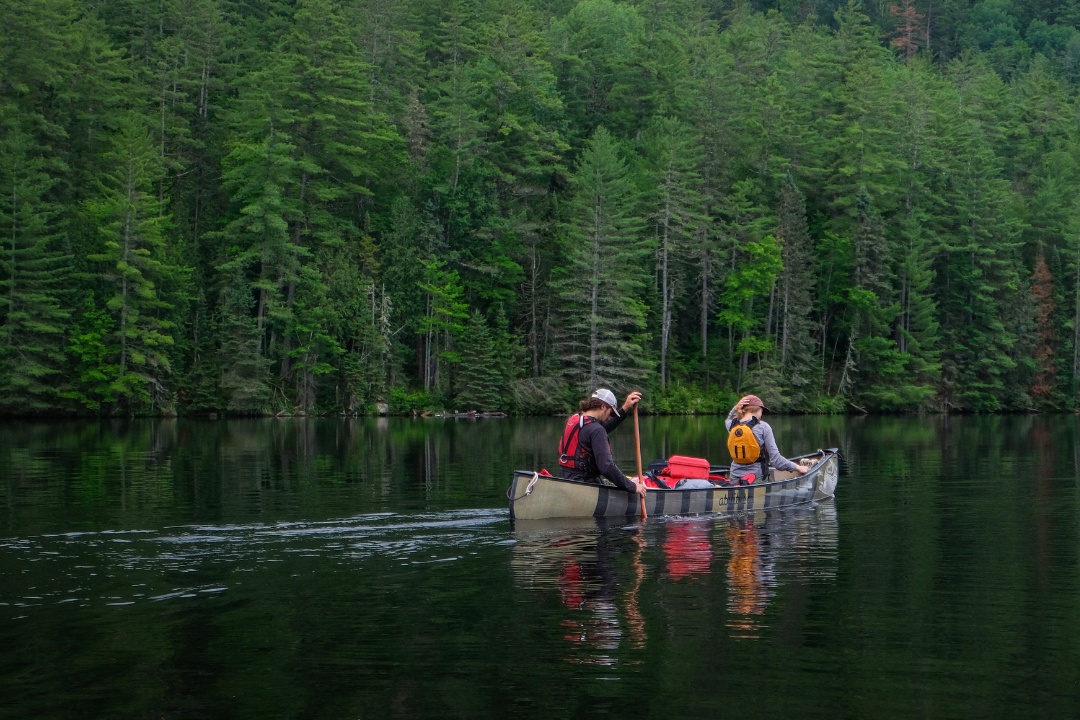
The Dumoine River is often described as one of the last great wild rivers in Quebec. With its countless rapids, towering cliffs, and largely untouched wilderness, it has become a dream destination for canoe-camping enthusiasts and whitewater adventurers. In this article, guide, adventurer and author Guillaume Rivest takes you along on his very first descent of this legendary river.
This article was written in collaboration with Guillaume Rivest and Hooké.

Join Guillaume Rivest on his adventure:
It’s one of those August mornings. The sun begins to pierce through the mist drifting slowly above the river. Not a breath of wind. The water is perfectly still. A smallmouth bass leaps from the water with a loud splash. I can’t help but think, “Rest in peace, fly that happened to be in the wrong place at the wrong time.” A little farther away, the canoes sit neatly lined up, patiently waiting to be launched once again.
The low rumble of the nearby rapid reminds me that, sooner or later, adrenaline will quickly replace the caffeine slowly making its way through my veins. One thing at a time. For now, I sip my coffee while taking in the slow-moving spectacle offered by the extraordinary wilderness of the Dumoine River. My friends move quietly or sit silently beside me, their eyes fixed ahead, as though respecting the sacredness of the moment. No one wants to disturb the deep peace that has settled over this perfect morning.

Photo: Guillaume Rivest
Located between the Témiscamingue and Outaouais regions, the Dumoine River is one of Quebec’s must-visit destinations for passionate canoeists.
This was my very first descent of this legendary river, known for its unique combination of technical rapids, breathtaking wilderness, and rich history. I’d heard about it more times than I could count. For some, paddling the Dumoine is a lifelong goal. For others, it’s an almost mythical place, existing somewhere between true wilderness and accessibility.
That feeling becomes even stronger when you consider its course. The Dumoine forms the boundary between Témiscamingue and the Outaouais. It begins in La Vérendrye Wildlife Reserve and flows for 150 kilometres before joining the Ottawa River. It is the last major wild river in the Ottawa Valley—the only one without a single dam altering its natural flow.

Photo: Matthieu Dupuis
The Dumoine River is renowned for its many rapids and long stretches of whitewater. Even before setting my canoe on the water, I knew it wouldn’t be a river that could be paddled without solid technical skills. While some sections remain relatively accessible, others demand the ability to read the river quickly, anticipate its movements, and make the right decisions at exactly the right moment.
Simply put, this is not a river for beginners.
The moment we launched, I quickly realized just how true that was.
The most popular starting point is located at kilometre 64 of the river, accessible by an old logging road.
We arrived there early in the afternoon. The launch drops directly into a Class II rapid stretching nearly 200 metres.
I trust my paddling partners, so we set off with little hesitation.
The riverbed twists from left to right.
In the first bend, right in the middle of the rapid, I was stunned to spot half of a canoe lodged high in the cedar trees several metres above the water. Most likely carried there by floodwaters, it was probably all that remained of an expedition that hadn’t ended well.
The warning couldn’t have been clearer: if you don’t have the necessary skills, don’t venture onto this river.
Before leaving, I had counted roughly 60 rapids along the route, ranging from very easy to completely unrunnable. Some stretch on for hundreds of metres, leaving paddlers with very little time to recover.
In short, experience is a tremendous asset.

Photo: France Lemire
Beyond its rapids, it was the river’s character that left the deepest impression on me. As the days went by, the landscapes seemed to grow more expansive, and the feeling of isolation became almost tangible. The Dumoine constantly gives you the impression of travelling through a wilderness that remains truly untouched, both breathtaking and untamed. It’s likely this balance between raw beauty and a genuine sense of remoteness that has earned the river its legendary reputation.
As I finished my coffee, I thought back to all the conversations I’d had about this river. People always told me the Dumoine was one of Quebec’s most beautiful rivers. Towering cliffs, old-growth forests, crystal-clear water, and the feeling of being completely alone in the world. It was said to be one of the favourite rivers of legendary canoeist and filmmaker Bill Mason, who paddled it every year. That morning, it was easy to understand why.
Lost in quiet contemplation as the sunrise unfolded in brilliant colours, a red-tailed hawk shattered the silence with its unmistakable cry, the same call often used in American films in place of the rather unimpressive call of the bald eagle. The moment could hardly have been more perfect, and without realizing it, the bird had just given us the signal to begin our second day on the river.
Throughout the day, one rapid followed another. Some could be run on sight, while others required scouting from shore to identify the safest line. Our feathered companion, the hawk, stayed with us for much of the day. By late afternoon, after completing a particularly technical stretch of whitewater, we emerged onto a small, calm pool surrounded by towering cliffs. The hawk’s nest was clearly nearby, and as if wishing us good luck, it let out one final cry that echoed throughout the valley. We all smiled, taking in the magnificent spectacle.
That evening, we found a campsite that could hardly have been more beautiful. Right in the middle of the longest portage, a stunning campsite overlooked a Class V rapid. That’s when I realized one of the “problems” with the Dumoine: every campsite calls to you. Every place has something unique that makes you want to spend the night there. If I’d had two months to paddle the river instead of a few days, I probably would have given in every time.
From our chosen campsite, the view was simply spectacular. Sitting around the campfire, we ate in silence as the sun slowly disappeared beyond the horizon. Lost in thought, I watched the flames dance. I thought about the hundreds of thousands of people who had travelled this river over thousands of years. Somehow, I like to imagine that I share with them the same deep appreciation for this land. I like to imagine that 5,000 years ago, an Anishinaabe paddler stood in awe before the same towering 150-metre cliff near the end of the river. Ultimately, travelling through this landscape feels like one of the most meaningful ways to connect with those who came before us.
Looking back, the Dumoine River did not disappoint. Its beauty is undeniably striking and unlike anywhere else. Is it Quebec’s most beautiful river? That’s a difficult question. I’d have to paddle the province’s 15,000 other rivers and streams, or perhaps its 3.5 million lakes, to answer with certainty. One thing is certain, however: Quebec’s past and present are inseparably tied to its waterways, and few experiences allow you to truly appreciate and explore this land quite like travelling by canoe.

Photo: Guillaume Rivest
While the Dumoine offers an unforgettable experience, it also requires careful preparation. Here are the key recommendations I would give to anyone planning to paddle this remarkable stretch of water or any other technical whitewater river in Quebec.
Get trained! Taking a course certified by Canot Kayak Québec is probably the best advice I can give. Besides being a lot of fun (seriously!), learning from experienced instructors allows you to progress much faster than relying on trial and error. It’s also the most effective way to develop the skills needed to paddle technical rivers like the Dumoine independently. These courses teach you how to recognize hazards on the river, one of the most essential skills any canoeist can develop.
Nothing replaces experience. Time spent paddling and camping teaches you about both your abilities and your limits. The more nights you spend outdoors and the more kilometres you paddle, the better you’ll understand what’s within your capabilities, and what might put you at risk.
An elephant is eaten one bite at a time. Start with shorter trips, and once you feel comfortable, gradually increase both the length and the difficulty of your expeditions.
Whenever you’re paddling a river for the first time, it’s wise to build extra time into your itinerary. Scouting rapids may take longer than expected, portage trails can be rough or poorly maintained, and unexpected delays are part of the adventure.
Besides, who would say no to a few extra nights on a dream river?
On technical rivers, always think about portaging. Almost every rapid can be portaged if necessary, but carrying poorly organized gear can quickly turn the experience into a miserable one.
Transport your equipment in large dry bags or portage barrels fitted with harnesses. Inside, organize your gear into smaller stuff sacks. Carrying one large bag filled with ten smaller bags is far easier than hauling ten loose bags scattered everywhere.
Think in terms of meals. One of the most common mistakes I see among people preparing for their first multi-day expeditions is bringing far too much food out of fear of running out. Instead, create a complete meal plan, prepare a detailed grocery list, and, most importantly, stick to it.
Be realistic about portion sizes as well. Yes, people generally eat more while on expedition, but it’s unlikely that someone who normally eats half a bagel for breakfast will suddenly eat three whole bagels every morning.
One trick I like is organizing food by day. For example, one bag contains everything needed for breakfast, lunch, and dinner on Day 1. That way, I don’t have to empty my entire food barrel looking for the spices needed for the first dinner.
Expect the unexpected. Murphy’s Law tells us that anything that can go wrong eventually will, and sometimes everything happens at once. Your communication device can fail just as someone suffers a serious injury.
For every outdoor trip, I strongly recommend using what we call a “guardian angel.” This is someone who knows exactly where you’re going and expects to hear from you at a predetermined time each day. If they don’t receive any news from you within a reasonable timeframe, they’ll know it’s time to contact emergency services.
No matter how short the outing, always bring a small “just in case” kit.
On every trip, I carry a first aid kit, a reliable communication device, fire-starting supplies, a water bottle, a snack, a small microfibre towel, and emergency clothing (essentially a rain poncho and a set of thermal base layers). Everything fits inside a waterproof bag of about 15 litres, compact enough to carry easily, yet capable of making a real difference in an emergency.