
3 Great Backpacks for Your Trip
Outdoor Activities | August 1, 2025
SAIL
June 3, 2026
Share


Sea kayak, river kayak, fishing kayak, hardshell or inflatable… There are many watercraft options for paddling the waterways of Quebec and Ontario. Bruno Clavette, expert at SAIL, breaks it all down so you can find the right kayak for you
In this article, you will discover how to choose the right kayak for your water adventures:
Finding the right kayak for your outings comes down to a few key factors. Here are the essential questions to ask yourself before picking one that’s right for you.
| Use | Water conditions | Recommended model | Key feature |
| Small lake / marsh | Calm | Recreational (sit-on-top) | Maximum stability |
| Large lake / river | Waves, wind | Sea kayak (sit-in) | Tracks well (length) |
| Rapids | Strong current | River kayak | Extreme manoeuvrability |
| Fishing | Any | Fishing kayak | Hands-free (pedal drive) |
Recreational kayaks are ideal for calm water such as lakes or slow-moving rivers. If you’re heading into rougher conditions, a sea kayak or a closed-cockpit river model is the way to go. These watercraft are built for manoeuvrability and track well through waves, wind, and turbulent water.
The longer the kayak, the easier it is to track straight and maintain stability. An elongated hull also glides more efficiently through the water, maximizing the reach of every paddle stroke. On the flip side, shorter kayaks are more responsive and forgiving when it comes to balance.
When choosing the right size, don’t forget to think about capacity. Consider who will be using it and whether you prefer paddling solo or tandem. Transport is also a key consideration: do you have a roof rack to strap a hardshell kayak to, need a compact model that fits in your vehicle, or would an inflatable kayak that fits in the trunk make more sense?
In a nutshell:
A recreational kayak is a great option for short outings or camping trips. For more demanding adventures, look to sea kayaks, river kayaks, or closed-cockpit models. And if fishing is your thing, a fishing kayak is purpose-built for exactly that.
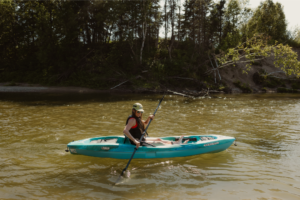
Sit-on-top kayaks are perfect for paddling on calm bodies of water. They can be inflatable or made of rigid plastic. Unlike sit-inside kayaks, where you’re seated partly below the water’s surface, sit-on-top kayaks offer a relatively high seating position. Because this position above the water is less stable, sit-on-top kayaks are wider to ensure optimal flotation. They also provide more room for movement, especially for the legs.
Who is it for? Paddlers looking for stability over perfomance.
A sit-on-top recreational kayak is ideal for beginner paddlers and anyone looking for a few relaxed hours on calm water.
These watercraft range from 8 to 13 feet (2.4 to 4 m) for a solo model and 13 to 15 feet (4 to 4.6 m) for a tandem. They offer outstanding stability, comfort (there’s an adjustable seat and moulded footrests to accommodate different leg lengths on most models), and multiple bungee cords on the hull for securing gear.
Most recreational kayaks are hardshell, but inflatables are gaining popularity. Made from rubber and filled with air, they tend to bounce slightly on the water. That said, they’re very stable and pack down compactly into a carry bag, making them easy to carry on your back. They’re also lightweight (around 40 lb./18 kg) and can be inflated or deflated in under 10 minutes with a foot pump.
Who is it for? Available in solo and tandem, it’s often the best option for families looking to get the whole crew into paddling. If that’s you, some brands like Pelican also make kayaks specifically designed for kids.
If you love fishing and want a quiet, peaceful way to get close to the catch, a recreational fishing kayak is a solid choice.
The vast majority of fishing kayaks feature an open cockpit for maximum space and freedom of movement. Their hull is designed to glide silently across the water while offering optimal stability and a comfortable platform for stand-up fishing. They also come loaded with multiple rod holders and plenty of storage for all your gear (fish finder, tackle box, water bottle, and more).
Some brands even carry pedal-drive fishing kayaks. The Sportsman PDL 120 Pro from Old Town and the Catch 110HDII from Canadian brand Pelican are great examples: perfect for keeping your hands free and your focus on the line.
Who is it for? Fishing enthusiasts with some kayaking experience.
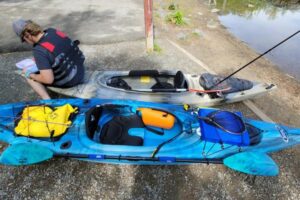
Sit-in kayaks work just as well for recreational paddling on calm water as they do for more demanding outings on the open sea or whitewater rivers. Their rigid plastic hull is sleek and low-profile, sitting close to the water’s surface for excellent stability and easy manoeuvrability. The closed cockpit shields your legs from the elements (waves, rain, wind, sun), and the internal compartments offer plenty of room to stow your gear.
Who is it for? Paddlers who prioritize performance over stability.
If you want to spend several hours on calm or slightly agitated waters, your best bet is a recreational sit-in kayak, such as the Pelican Rise 100X, or the Argo 136XP if you’re looking for a tandem model. Sometimes referred to as touring kayaks, recreational kayaks are incredibly versatile. They are sturdy and made of rigid plastic, and they sometimes have a rudder to make steering left and right a breeze.
Who it for? Intermediate and advanced kayakers
If you’re an experienced kayaker who wants to spend several days on large lakes and rivers or at sea, you need a sea kayak.
Sea kayaks always have a rigid, sit-inside design. They are also frequently equipped with a rudder or centreboard to maximize manoeuvrability, and have several watertight compartments to carry camping gear and the necessities for a day on the water. They range in length from 13 to 18 feet (4 to 5.5 metres). It is a good idea to use a nylon or neoprene skirt to prevent water from entering the kayak when going over large waves.
Who is it for? Experienced kayakers.
These kayaks are built specifically for river running with rapids, ranging from Class I (easy, great for beginners) to Class V (obstacles, drops, and strong currents — experts only). Short (between 6 and 8 feet) and incredibly tough, river kayaks feature a distinctive upturned bow. They’re extremely manoeuvrable, but demand a solid understanding of whitewater navigation and rescue techniques (such as the kayak roll). River kayaking is a relatively dangerous sport and should never be practised alone.
Who is it for? Experienced and expert paddlers only.
Focus on water-resistant or quick-drying materials to ensure optimal comfort and protection from the elements. Remember to bring a change of clothes and extra layers: a rain jacket, UV-protective clothing, a warm sweater… Keep them dry with a good, watertight dry bag, which can also safely hold your keys, cell phone, camera or any other precious item.
Choose a paddle specifically adapted to your use. Some models are versatile and suitable for all kinds of recreational activities, like adjustable paddles, which have the added benefit of adapting to different kayak sizes (and paddler heights). There are also paddles designed specifically for fishing. For example, the Poseidon Angler from Pelican includes a hook retrieval system built into the blade and a measuring tape along the shaft to measure your catch of the day.
Always have a life jacket or personal flotation device (PFD) with you for safety and to reduce the risk of drowning. Find the right model for you with our article on the best types of PFDs for every nautical activity.
This is a must-have accessory to ensure your food and drinks stay cold, especially in hot weather. If you are fishing, a cooler is also the best way to keep your bait and catch cool.
It’s always a good idea to bring along some sort of navigation tool, especially if you’re going on a long expedition or paddling large bodies of water. Remember to pack a map in your dry bag whenever you venture into unfamiliar areas. For even greater accuracy, consider a GPS, which will always get you to your destination.