Hunting bow or crossbow: which one should you choose?
Hunting | September 23, 2026
SAIL
September 22, 2026
Share


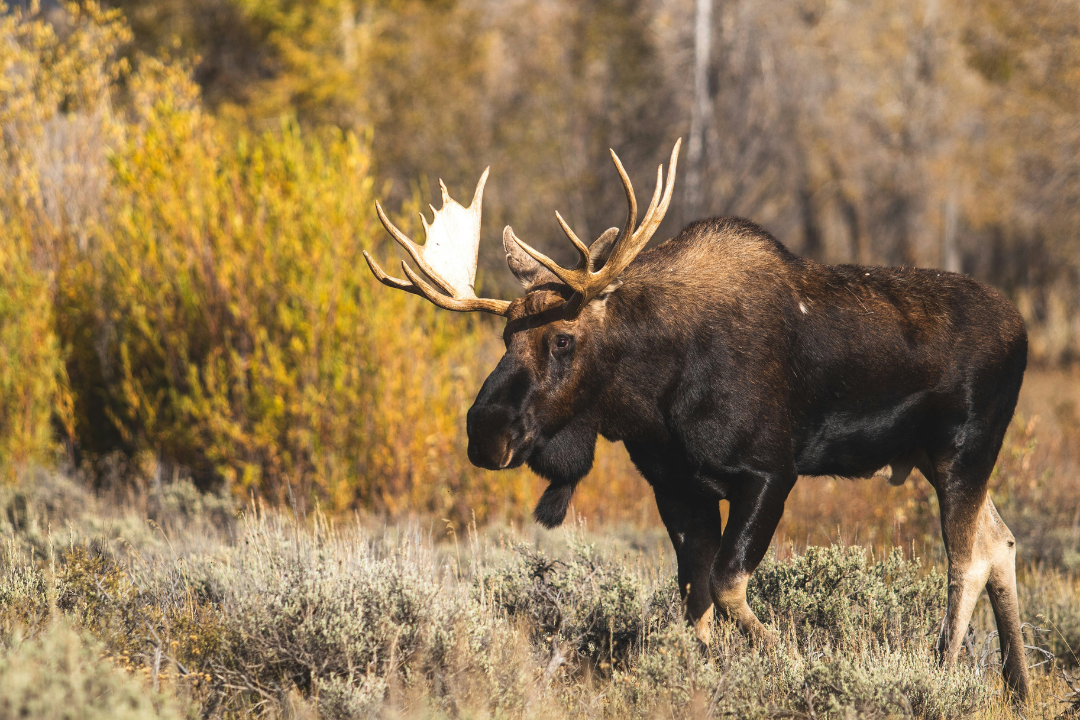
Bow hunting moose is considered one of the most intense experiences a moose hunter can have in Quebec. It requires patience, a strong knowledge of the territory and a mastery of moose calling techniques to get close enough to this impressive animal. In this article, Guillaume Rivest, guide, adventurer and author, takes you through his first successful moose harvest with a bow in the heart of Témiscamingue and offers a comprehensive moose hunting guide to help you prepare for your next hunt.
This article was written in collaboration with Guillaume Rivest and Hooké.

Follow Guillaume Rivest on his adventure:
It’s October 3. 7 a.m. Slowly, very slowly, I paddle my canoe as quietly as possible into a small bay on a lake deep in the Témiscamingue region. A branch breaks for the second time. This time, I’m convinced it’s a moose, and it’s very close. I let out a cow call. The only response is more cracking branches, suggesting that the massive animal is slowly making its way toward me. I hear its antlers brushing through the alders. Adrenaline takes over. My heart starts racing. I tell myself: “Stay calm.” Deep down, I know this hunt could end with my first-ever moose harvest with a bow.
After many twists and turns, two hours later I find myself in a marshy basin near the top of a hill, almost a kilometre from the lake where I had been canoeing. In front of me, a cow is casually feeding on leaves, completely unaware of my presence, convinced that I’m a young bull who has come to challenge the “big buck” in the area. I’ve lost track of the bull, but if the cow is here, he can’t be far away.
Armed with my makeshift antlers (in this case, a dry maple branch), I mimic a moose rubbing its antlers against the only fir tree in the area. I let out a call that, in moose language, essentially means: “Come fight me!” In hunting terminology, this is known as a “raking” or “rub” call.
One minute later, everything happens at once.
On the other side of the basin, I hear the loud cracking of branches. Something big is literally snapping small trees as it makes its way down the slope. Then, for the first time, I hear the bull vocalize. The guttural sound of his call fills the entire valley and seems to reverberate through my bones. He has answered my call with an unmistakable message: “I’m coming to fight.”
If I’m being 100% honest with you, the fear was stronger than the excitement. There I was, in the middle of the small valley, armed with four arrows. And there he was—a 1,200-pound beast, none too happy to know I had been near his cow for so long.
I had to talk myself through it: “Stay calm! You’ve been waiting four years for this harvest! This is it! Take a deep breath. You’re going to do what you need to do and see it through to the end.”
Like an athlete, I entered the zone. Nothing else existed except the present moment, me, and the very angry, imposing beast.
He gets closer. Eventually, I catch sight of him. His massive antlers swaying from side to side, he’s coming straight toward me, staring me down while letting out aggressive grunts. With an arrow nocked and my bow drawn, I answer his challenge, swaying from side to side in return.
Fear takes over. He’s 10 metres away, still facing me head-on. There’s no shot.
Just as I start to seriously worry about my safety, he decides to circle around me, moving behind a small patch of alders. He’s broadside now, but I still have no clear shot. I spot an opening four metres away from me. I aim at the gap, thinking that when he passes through that spot, it will probably be my only chance to release an arrow.
The moose moves forward. I release the arrow, striking him squarely in the chest. Startled, he breaks into a run, only to collapse two minutes later. My broadhead went through the lung and pierced his heart.
Still standing there alone in the woods, shaking uncontrollably, I’m completely overwhelmed by the moment.
Nothing—absolutely nothing—has ever made me feel so much emotion in my entire life. I take a moment, mark the location on my GPS, and head through the woods toward my canoe. I need to go get my hunting partners. The race against the heat has begun, and we need to get the carcass cooled down as quickly as possible.
It’s 9:15 a.m. For a little context, it will be 11 p.m. by the time we finish hanging the moose quarters near our camp.
I experienced the hunt of a lifetime, but this story could have turned out very differently if I had been poorly prepared or equipped. Moose are prey animals that spend their lives evading predators. One mistake and your hunt could be over. The massive animal will be gone.
Here are a few tips to help you prepare for a successful moose hunt.
To maximize your chances of success, it’s essential to know your quarry. You need to understand its habits, feeding patterns, the sounds it makes and what they mean, as well as how it reacts depending on the stage of the rut, its sex, age, and more. This knowledge will help you make the right moves at the right time.
There are plenty of resources available to learn more, including books and online videos. We always keep several books at our hunting camp. My go-to resource: Jason Morneau Tremblay’s online courses. Without a doubt, they’ve helped me the most over the years.
You need to hunt in suitable habitats where signs of moose presence can be observed. The most effective way to get to know your hunting territory is to explore it thoroughly. For those who don’t have the opportunity to scout their hunting territory before the season opens, forest ecosystem maps can be a valuable tool.
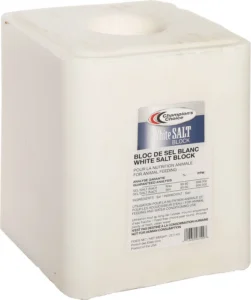
If you’re lucky enough to have access to the same territory year after year, it can be well worth improving and maintaining it. Clearing trails will allow you to move around more quickly while making less noise. Placing salt blocks in suitable areas may also encourage moose to stay longer on your territory. I’m lucky to have my brother-in-law as a hunting partner, and he puts a lot of effort into this. In fact, I harvested my moose fairly close to a salt block he had placed the previous winter.
If someone could hear me when I’m alone in the car before the hunt, they’d probably think I was pretty strange. Moose calls play on repeat while I do my best to imitate them. Only practice will help you develop a call that might eventually fool a moose.
Few things frustrate me more than hearing about a moose being wounded because of a malfunctioning hunting weapon or an inexperienced shooter. Whether you’re using a firearm, crossbow or bow, accuracy takes practice. EVERY RESPONSIBLE HUNTER should pass on a moose if they have any doubts about their abilities when the opportunity to take a shot arises.
Maintain your equipment before heading out to hunt and, most importantly, practise with your hunting weapon.
Moose have excellent hearing and an exceptional sense of smell. Their eyesight, however, leaves something to be desired. Dark-coloured clothing generally works very well. For still hunting, your clothing should be quiet, with no fabric rustling or rubbing sounds. During my hunt, I wore Hooké’s Prospector merino wool sweater and Adventure cargo pants. Both were solid green with no pattern, and they didn’t work against me when two moose looked directly at me one after the other.
When it comes to scent, try to avoid overheating to minimize the smell of sweat. Personally, I really like wool clothing because it tends to retain much less odour after exertion than synthetic alternatives. You can also use scent-control sprays on your hunting clothing, with real moose urine being one of the most effective options. But no matter how much urine you spray on yourself, the most important factor is to pay attention to wind direction during your approach.
Recommended moose hunting products:
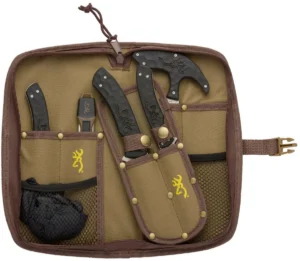
The real work begins once the animal is down. You need a lot of equipment to field dress, break down, saw through bone, and transport a moose carcass that can frequently weigh over 1,000 lb. Once the animal is down, if temperatures are even moderately warm, cooling the meat becomes an absolute priority to limit bacterial growth.
In short, you’ll need at least a few good knives, zip ties, a bone saw, straps, carabiners and rope.
We’ve gotten into the habit of preparing everything in advance and keeping it in a bag at our hunting camp, along with water and snacks, so it’s always ready in case someone takes an animal.
When hunting, as with any other outdoor activity, it’s important to understand the risks involved. You should always carry the following with you:
In the event that you get lost or injured, you’ll have what you need to get yourself out of a difficult situation. Keep in mind, however, that none of the items on this list will be of much use if you don’t know how to use them properly.
Share